
1. Why Are Tantalum Capacitors Used in SSDs?
Why do tantalum capacitors appear in SSDs? Before answering that question, let us look at what an SSD is and how a tantalum capacitor works.
What Is an SSD?
An SSD, or Solid State Drive, is a storage device based on semiconductor NAND flash memory. Unlike a conventional mechanical hard disk, an SSD has no moving mechanical parts and reads and writes data entirely through electronic signals.
An SSD mainly consists of a printed circuit board and several core chips:
Controller: The brain of the SSD. This microprocessor manages data reads and writes, garbage collection, wear leveling to distribute wear across memory blocks, and error correction. Its algorithms directly affect performance consistency and service life.
NAND flash: The SSD's data warehouse, where information is actually stored. Common types include SLC, MLC, TLC and QLC, which differ in storage density.
DRAM cache: High-performance SSDs use DRAM as a staging area for frequently accessed data and the mapping tables that track where data is stored. This improves random read and write efficiency. SSD transfer speeds can range from 500 MB/s to 14,000 MB/s.
What Is a Tantalum Capacitor?
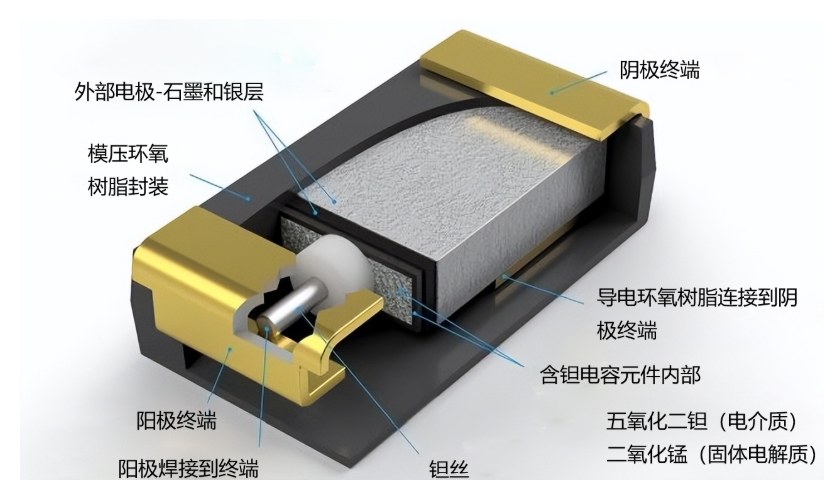
A solid tantalum electrolytic capacitor is a type of electrolytic capacitor. Its distinguishing feature is the use of tantalum, a rare metal, as the positive electrode, or anode. Its structure includes:
Anode: Extremely fine tantalum powder is pressed into shape and sintered at high temperature to form a porous, sponge-like pellet. This structure provides a very large internal surface area.
Dielectric: An extremely thin layer of tantalum pentoxide is chemically formed on the surface of the porous tantalum pellet. This thin, stable insulating film is central to achieving high capacitance in a small package.
Cathode: Conventional tantalum capacitors use manganese dioxide as the solid electrolyte, while modern high-performance types use conductive polymer for improved performance and lower internal resistance.
Tantalum capacitors offer several advantages:
- Compact size and high capacitance. For the same capacitance, tantalum capacitors can be much smaller than aluminum electrolytic capacitors. They help filter power-supply noise and ripple, providing a stable supply to downstream circuits.
- Transient energy support. When downstream IC power consumption increases, their stored charge can quickly supply the temporary current demand and help keep the system stable.
- Temperature performance and service life. A solid electrolyte avoids the liquid leakage and drying associated with liquid-electrolyte capacitors. Devices are available for operation from -55°C to 125°C.
- Stable capacitance. Tantalum capacitors have little DC-bias-related capacitance loss, helping their working capacitance remain close to its nominal value.
- Low ESR. Low equivalent series resistance supports rapid charge and discharge, ripple filtering and transient current delivery.
These characteristics make tantalum capacitors useful in space-constrained equipment such as smartphones, SSDs and computers. With the basic structures established, we can return to the original question.
Why Put Tantalum Capacitors in an SSD?
Enterprise and industrial SSDs need high read and write performance. SLC (single-level cell) memory is one option for high-end storage. Before data reaches NAND flash, it may be temporarily held in DRAM, which is fast but loses its contents when power is removed. Tantalum capacitors can support power-loss protection and stabilize the supply during intensive data transfers.
- They combine compact size, high capacitance, low ESR and stable capacitance.
- At the instant power is lost, they can provide temporary backup energy, giving the controller time to save data.
- During high-power data transfers, they help maintain a stable supply so the transfer can complete reliably.
- The limited space inside an SSD favors compact capacitors over larger conventional electrolytic devices.
- Their solid electrolyte avoids liquid leakage and drying, while their stable capacitance supports reliable operation over time.
2. Tantalum Capacitor Failure Modes
Tantalum capacitors also have limitations. Their use of tantalum makes them more expensive than many conventional capacitors. They are polarity-sensitive and require careful voltage selection. They are not a replacement for MLCCs in every high-frequency application.
In engineering applications, failure mechanisms can be grouped into seven categories.
1. Overvoltage and Voltage Surges
The tantalum pentoxide dielectric is extremely thin to achieve high capacitance in a small volume. Applying voltage above the rated value can break down this insulating layer, allowing current to flow between the electrodes and causing a short circuit.
To reduce this risk, select an appropriate voltage rating with margin above the operating voltage. An upstream TVS diode can also help clamp surge voltage.
2. Surge Current
At power-up, the low ESR of a tantalum capacitor can allow a large charging current. According to Ohm's law, I = V/R, low resistance can produce a substantial current. Combined with voltage surges, this stress can damage the dielectric and cause a short circuit.
A series resistor or appropriately selected ferrite bead can help limit peak current. In high-end SSDs, a power-management IC can provide controlled soft start.
3. Reverse Polarity
Like other polarized electrolytic capacitors, tantalum capacitors have positive and negative terminals. Reverse voltage can damage the internal insulating layer and result in a short circuit.
Use clear polarity markings on the PCB silkscreen and automated optical inspection (AOI) to check component orientation after assembly.
4. Excessive Ripple Current and Thermal Stress
AC ripple current generates heat in the capacitor's ESR. Excessive ripple or inadequate cooling raises the internal temperature. In conventional manganese-dioxide tantalum capacitors, the cathode material can release oxygen at very high temperatures, around 500°C. This can promote a vigorous reaction with tantalum and damage the component.
Calculate the expected ripple current and keep it within the limits in the capacitor datasheet. Conductive-polymer tantalum capacitors are another option. Their polymer cathode does not provide the same oxygen-release mechanism as manganese dioxide, reducing the risk of ignition; electrical failure can still result in a short circuit.
5. Mechanical and Thermal Stress
Excessive placement force during surface-mount assembly, or overly rapid heating and cooling during reflow, can create microcracks in a capacitor's internal structure. These cracks may grow during operation, eventually increasing leakage current or causing dielectric failure.
Optimize placement pressure and follow the specified reflow temperature profile. Avoid steep thermal gradients and keep capacitors away from areas of the PCB likely to bend or concentrate mechanical stress.
6. Environmental and Moisture-Related Stress
Some tantalum capacitors use non-hermetic epoxy-molded packages. During prolonged exposure to high humidity, moisture can enter the package. Rapid heating during power-up or reflow may vaporize that moisture, creating pressure that damages the dielectric or package.
Components or boards stored in humid conditions may require a controlled drying process before assembly. For demanding environments, consider hermetically sealed tantalum capacitors using metal cases and glass seals, following the manufacturer's handling requirements.
7. Intrinsic Defects
Impurities in tantalum powder or shortcomings in the sintering process can leave microscopic defects in the oxide layer. These defects may not be detected during initial testing. Under prolonged electrical stress, leakage can gradually increase and develop into thermal breakdown.
Apply incoming inspection of DC leakage (DCL) and select suitable high-specification capacitors, including the YMIN products discussed in this article.